Influencers, Children’s Herbal Health, and Why Herbal Education Matters
The scroll-and-dose problem
A parent with a feverish toddler at 2 a.m. does not open a materia medica. They open their phone. Within thirty seconds, an influencer with a ring light and a basket of dried herbs is telling them which tincture to put under their child’s tongue, how many drops, and why the pediatrician is wrong.
I have taught herbalism since 1998, and I love that more people than ever want plants in their family’s life. That is the good news. Additionally, the bad news is that the loudest voices on children’s herbal health are now the least trained, and children are paying for it.
What goes wrong when influencers advise on children’s herbs
The platform rewards confidence, not accuracy. A thirty-second video cannot hold a dosing chart, a contraindication list, or the phrase “it depends on the child.” So those parts get cut, and what is left looks simpler and safer than it is.
Here is what I see, over and over.
-
Adult doses on child bodies.
A tincture that is fine for a 150-pound adult is five to seven times too strong for a toddler. Most videos never mention weight at all.
-
Honey and raw remedies for infants.
Honey elderberry syrup, honey-based cough blends, raw garlic honey. Honey carries a real risk of infant botulism under one year, and it is still recommended to babies every day online.
-
Essential oils as if they were herbs.
Peppermint and eucalyptus near an infant’s face can slow breathing. Undiluted oils on skin, oils in a bath, oils “a drop in the water bottle”: all common, all wrong, and none of it is herbalism.
-
Herbals with real toxicity sold as gentle.
Comfrey teas for “gut healing,” pennyroyal for fevers, lobelia for croup, goldenseal for every cold. These plants have pyrrolizidine alkaloids, hepatotoxic ketones, and alkaloids that have hurt children in published case reports.
-
Herbs instead of care, not alongside it.
A fever that climbs, a stiff neck, a baby who will not feed, a child who is breathing fast: these are not herbal moments. The influencer is not there at 4 a.m. when the chamomile does not work.
-
Selling as teaching.
Many of these accounts are storefronts. The affiliate link is the point; the child is the marketing.
None of these people are villains. Most are parents who had a good experience with a plant and want to share it. The problem is that enthusiasm has been mistaken for training, and the algorithm cannot tell the difference.
Children are not small adults
This is the sentence every trained herbalist learns early and every viral video skips. A child’s liver enzymes mature over the first years of life, so constituents that an adult clears in hours can linger. A child’s skin is thinner and absorbs more. A child’s airway is narrower, so a menthol vapor that opens an adult’s nose can tighten an infant’s breathing. A child cannot tell you that the tea made their stomach hurt or their heart race.
Dosing is a Calculation
Dosing is a calculation, not a guess. Clark’s rule (child’s weight in pounds divided by 150, times the adult dose) is the simplest version; a trained herbalist also knows which herbs do not scale at all because they are inappropriate for children at any dose. The right answer for a feverish toddler is usually the gentlest thing that works: lukewarm chamomile or catnip tea, elderflower, fluids, rest, and a clear sense of when the fever itself is the reason to call.
The gentle herbs are gentle precisely because someone learned which ones they were.
Why an herbal education matters
-
Learn the plant, not the trend.
Latin name, family, part used, constituents, actions, energetics. When a new “miracle” herb hits your feed, you can look at its chemistry and know in a minute whether it belongs near a child.
-
You learn to dose.
By weight, by age, by preparation. You know that a glycerite, a tea, and a tincture of the same herb are three different strengths, and you know why honey is not a sweetener for a baby.
-
The Avoid List: You learn the avoid list and why it exists.
Pyrrolizidine alkaloids, berberine, thujone, pulegone, anthraquinones. These names are not trivia. They are the difference between a tea and a trip to the emergency department.
-
Evidence Matters.
A trained herbalist can tell a case report from a cohort study from a sponsored post, and can say “the data are thin” out loud without feeling threatened by it.
-
Interactions Matter.
Children are on medications too: antibiotics, asthma inhalers, seizure drugs, ADHD stimulants. An herbalist knows St. John’s wort changes how those drugs are metabolized. An influencer does not know what the child is taking.
-
Scope of Practice.
The most important skill in any herbal program is knowing when herbs are not the answer. Fever with a rash, labored breathing, dehydration, a lethargic infant: a trained person refers, fast, without apology.
-
“I don’t know.” The most powerful sentence you can say.
Education replaces confidence with competence, and competence includes knowing your limits.
Parents who take a real herbal course do not become less interested in plants. They become more useful. They can make a chamomile glycerite a three-year-old will drink, build a first-aid kit with calendula and plantain instead of pennyroyal, and recognize, at 2 a.m., that this is a night to call the nurse line rather than the comment section.
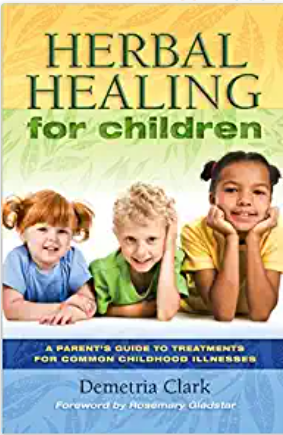

Learn it properly
Moreover, the plants are not the problem. Chamomile has soothed children for a few thousand years and will go on doing it. The problem is a culture that treats a short video as a substitute for study, and treats children as the test group.
If you want to use herbs with your family, learn them the way you would learn anything that can help or harm a child: from people who have done it for decades, with the chemistry and the safety taught alongside the recipes. At Heart of Herbs we have taught exactly that since 1998, and every children’s herbalism lesson we offer begins with the same question the influencers never ask: how much does this child weigh, and what else is going on?
Ask that question first. Then make the tea.
Disclaimer
Blog Post Disclaimer
The information presented on the Heart of Herbs Herbal School/Demetria Clark websites is for educational purposes only. Heart of Herbs Herbal School/Demetria Clark Education LLC makes neither medical claims nor intends to diagnose or treat medical conditions. Links to external sites are for informational purposes only. Heart of Herbs Herbal School/Demetria Clark neither endorses them nor is in any way responsible for their content. Readers must do their own research regarding the safety and usage of any herbs, recipes, or supplements.